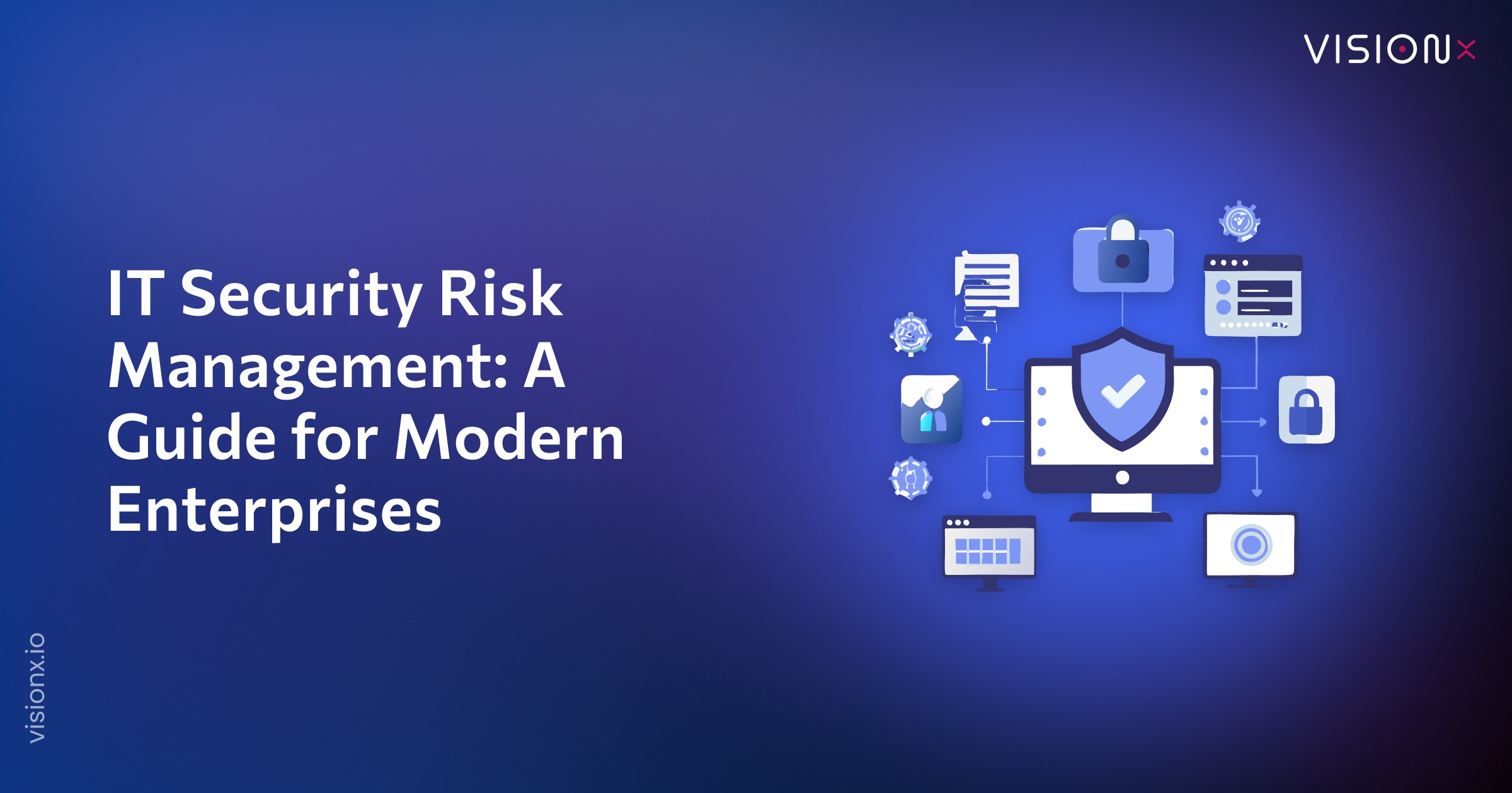
As businesses continue to expand their online presence and digitize operations, their exposure to cybersecurity risks increases as well. Such cyber risks are now directly business risks. And protecting the IT infrastructure of your company is now as important as it is to put security outside of your office building, perhaps even more important, because the risks in the digital sector are more diverse and complicated.
In this guide, we will explore IT security and risk management in depth, along with how to tackle this issue and how companies like VisionX can partner with you to overcome your challenges.
Key Takeaways
- IT security risk management connects cybersecurity controls directly to business risk, ensuring protection is focused on what matters most.
- Risk-based prioritization is essential, since vulnerabilities in critical systems carry far greater impact than those in low-value environments.
- Frameworks such as NIST and ISO provide structure, but meaningful risk decisions require continuous, data-driven insight.
- Ongoing monitoring and automated testing are more effective than static, annual risk assessments.
- AI-driven analytics improve threat detection, risk scoring, and response speed across complex IT environments.
- Governance, accountability, and employee awareness are foundational to sustaining a strong security posture.
- VisionX enables organizations to unify risk analytics, security operations, and business context into a single, actionable view of enterprise risk.
The Fundamentals of IT Security Risk Management
As we discussed that digital risks are now bigger than physical risks for your business, IT security risk management has become a board-level priority for any enterprise that is ambitious to grow online.
Remote workforces are in trend, most operations are being shifted to data-driven methods, and digital footprint across cloud platforms is also on the rise. All of this indicates that your organization needs a structured and business-aligned way to understand what kind of threats you are exposed to, which risks matter the most, and how you should allocate resources for maximum organizational protection.
This structured way is provided by IT security risk management. It is the systematic process of identifying, analyzing, and then controlling the risks in an organization’s information systems, data, and digital operations. Instead of focusing only on the technical vulnerabilities, it goes beyond and evaluates the risks based on three distinct factors:
- The value of an asset.
- The likelihood of a threat exploiting a weakness.
- The potential business impact if such an exploit happens.
Once such a proper framework is in place, it allows you to move from a vaguely defined idea of being secure to a more measurable and prioritized decision-making approach on what to protect and why.
What IT Security Risk Management Means Beyond Compliance
The best thing about IT risk management is its broad scope, which encompasses all your digital infrastructure. It naturally includes cloud services, applications, endpoints, user identities, third-party access permissions, and sensitive data. It is important to note that proper risk management is very different (and more robust) than the usual compliance programs.
An IT compliance program simply defines the minimum standards an organization needs to stay secure. On the other hand, IT risk management is about prioritization and taking action accordingly. It ensures that the most critical systems and processes receive the strongest protection, based on an analysis of real business impact.
In essence, there are four continuous activities in any risk management program:
- Identifying the assets, the associated threats, and vulnerabilities.
- Analyzing the likelihood and impact of different risk scenarios.
- Treating risks through mitigation, transfers, acceptance, and avoidance.
- Monitoring changes in the environment.
These four combined form a living, data-driven process that ensures business resilience and security.
The Business Impact of IT Risks
It is imperative to dig a bit deeper into how IT risks can impact the overall business operations, including sensitive and financial elements.
Let’s take the example of a ransomware attack. Ransomware attacks happen when a hacker captures your data and threatens you to pay them in exchange for getting your data back. If you don’t pay, they might delete your data, permanently damaging your business operations.
Another example is of data breaches. If your data is breached and leaked, it can bring legal liabilities, regulatory fines, and long-term damage to customer trust. Even minor security incidents consume executive time and divert a business’s resources.
For personnel managing information security, such as CIOs and CISOs, unmanaged risks can halt the organization’s growth by derailing cloud migration, application modernization, or any data analytics initiatives. The challenge here is not only to prevent attacks but also to prove that investments towards information security are reducing the organization’s overall risk exposure.
Real World Consequences of Poor Risk Management
There have been numerous cases where technical vulnerabilities in information systems have led to serious business disasters.
One big example is that of the Equifax data breach. It was a major disaster where hackers stole the personal information of more than 140 million people. This included their names, social security numbers, and credit details. It happened because Equifax failed to fix a known software weakness in time.
The attackers exploited a known Apache Struts vulnerability (CVE-2017-5638) on an unpatched Equifax web server, which allowed them to execute commands remotely and gain access to internal systems. From there, they queried databases and quietly exfiltrated sensitive customer data over several weeks without triggering security alerts.
IT security risk management is about finding such risks early, patching systems, and monitoring threats before attackers can use them. If Equifax had managed these risks properly, the breach could likely have been prevented or limited.
IT Security Risk Management Frameworks and Standards
To manage IT security risks and avoid disasters like the one discussed above, you need to rely on established frameworks and standards that provide structure, consistency, and a shared language between the technical teams and business leaders.
These frameworks are not intended to replace judgment or strategy; they offer proven models for organizing and prioritizing security activities so that nothing critical is overlooked.
Commonly Used Frameworks
Several frameworks are widely adopted across industries:
- NIST Cybersecurity Framework (CSF): One of the most widely used frameworks, NIST CSF groups security work into five areas—Identify, Protect, Detect, Respond, and Recover—making it easier to manage security across the full lifecycle of an organization’s systems.
- ISO/IEC 27005: Part of the ISO 27000 family, this standard focuses on managing information security risks and provides a clear, step-by-step way to identify, analyze, and reduce those risks.
- OWASP: The Open Web Application Security Project focuses on application and software security, helping organizations understand common vulnerabilities and where software risks are most likely to appear.
- FAIR (Factor Analysis of Information Risk): FAIR uses numbers and data to measure cyber risk, allowing organizations to express security risks in financial terms, which helps leaders make better business decisions.
How Frameworks Work Together
In practice, organizations rarely rely on a single framework. Usually, it’s always a combination of different frameworks that work in combination to power the entire security infrastructure.
For instance, a financial institution might use NIST CSF to structure its overall security program, along with ISO 27005 to guide formal risk assessments. They might also be using OWASP at the same time to manage app-level risks.
This layered approach allows the security teams to operate with precision and clarity.
VisionX can help you operationalize these frameworks by translating high-level or theoretical guidance into actionable workflows, controls, and dashboards. With such help, organizations can maintain a live and continuously updating view of their risk posture that aligns with recognized standards, without having to rely on static documents.
The Risk Management Lifecycle — Explained Step by Step
As you can guess by now, the entire IT risk management project is not a one-time thing; it’s an ongoing task with its own defined lifecycle.
Let’s dig deeper into the steps involved in a proper risk management lifecycle:
Step 1 – Risk Identification
The first step is to understand what needs to be protected and what could go wrong if we don’t. This begins with the creation of inventory assets, including applications, infrastructure, cloud services, data repositories, and user identities. Because without a clear picture of what exists, it is nearly impossible to understand where risk may be concentrated.
Once these assets are all identified, the next step is to map our potential threat sources. These can include external attackers, malicious insiders, compromised third-party vendors, and sometimes even accidental errors by employees.
At the same time, all vulnerabilities, such as unpatched software, misconfigured cloud storage, or weak authentication controls, are documented.
Step 2 – Risk Assessment
Once the identification and documentation are complete, the risk assessment phase begins. In this step, the IT personnel will evaluate how likely each threat scenario is and how damaging it can be if it occurs.
The exact method of this varies, as some organizations use quantitative models based on financial impact and probability estimates. While others may employ more qualitative ratings, such as high, medium, or low.
The goal here is not to reach a perfect assessment, because there would always be some imperfection, no matter how tight your assessment is. Rather, meaningful prioritization is the main goal here. By scoring the risks based on likelihood and impact, security teams can identify which risk exposures require immediate attention.
Step 3 – Risk Treatment
Once the risks are prioritized, you have to decide how to handle them. There are four primary options here:
- Avoid risk by eliminating the vulnerable system or process.
- Mitigate the risk through technical or procedural controls.
- Transfer the risk through insurance or outsourcing.
- Accept the risk when the cost of mitigation exceeds the potential impact.
The decision on the right option should be made after close collaboration between security teams and business leaders. It should be based on business objectives, regulatory requirements, and risk appetite, not just technical feasibility.
Step 4 – Monitoring and Review
The landscape in which your organization operates is always changing. New apps are deployed, employees join and leave, and attackers keep developing new methods.
Continuous monitoring ensures that your assessments are accurate and that your controls are performing as intended.
The most common monitoring features you find in modern platforms include automated scanning, real-time telemetry, and analytics dashboards. These help you to adjust your security posture before a minor risk becomes a major incident.
Tools and Techniques for Effective IT Security Risk Management
As it’s not possible to manage cyber risk at an enterprise scale with manual processes, your organization would need to rely on an integrated set of security tools and analytics platforms.
Security Information and Event Management (SIEM)
SIEM platforms collect and correlate security events from across your organization, including servers, endpoints, firewalls, and cloud services. By centralizing this data, they help detect suspicious activity early and highlight where security controls may be weak.
Vulnerability Assessment and Penetration Testing
Vulnerability scanners find weaknesses in systems and applications, while penetration testing simulates real attacks to see how serious those weaknesses are. Together, they show which issues are most likely to cause real risk.
Threat Intelligence Platforms
Threat intelligence tools add external data, such as known attack methods and active threat campaigns, to internal security information. This helps teams focus on risks that are actually being exploited.
AI-Driven Risk Analytics
Machine learning and AI in risk management help detect unusual behavior, predict attacks, and connect signals across complex environments. Platforms like VisionX use these insights to provide a continuously updated view of enterprise risk and support faster security decisions.
By combining these tools, organizations can move from reactive security to a proactive, risk-based approach aligned with real business impact.
Organizational Considerations for People and Processes
No matter how good your tech stack is for this purpose, it alone won’t determine your organization’s risk posture. The effectiveness of your IT security risk management depends just as much on how people work together and how security processes are embedded into daily operations.
First of all, clear governance is essential here. Roles and responsibilities need to be clearly defined. Everyone should be assigned their duties and expectations, from executive leadership to security operations teams.
The CISO typically sets the strategy and risk appetite, but the system admins and developers must be accountable for managing the risks associated with their environments.
Once the accountability is defined, the next step is to ensure a risk-aware culture. All employees play a central role in cybersecurity, whether through the way they handle data, respond to suspicious emails, or configure systems. Therefore, training and awareness are essential for the staff, so they understand how their actions can affect the overall organization’s risk exposure.
Lastly, risk management and incident response should not operate in isolation. Insights from past incidents and near misses should feed directly back into risk assessments, helping organizations refine their priorities and improve controls. Likewise, understanding which systems and data carry the highest risk allows incident response teams to act more decisively when an attack occurs.
Measuring Risk Management Success
Without clear metrics, your organization won’t be able to determine whether its risk posture is improving or if security investments are delivering value.
Common indicators include risk reduction over time, the number of critical vulnerabilities resolved, and operational metrics such as mean time to detect and respond to incidents.
A bonus would be a well-put-together executive dashboard that translates these metrics into business impact, such as potential financial exposure, so that leaders can make more informed decisions and stay up to date with their organization’s risks.
How VisionX Helps in IT Security Risk Management
As you can see by now, IT risk management is a foundational capability that protects revenue, reputation, and operational smoothness. If your business has the right stack of frameworks, technologies, and governance, you can gain clear visibility and make more confident and data-driven decisions.
Get in touch with VisionX today to enable such a transformation for your organization!