Consumer sentiment shifts week to week, and a decision made from last month’s report is a decision made late. Most teams can already say what their customers did. Far fewer can say what those customers will do next, and that gap is where revenue quietly leaks away.
According to research, the global predictive analytics market is valued at $27.56 billion in 2026 and is projected to exceed $116 billion by 2034, as companies rush to implement AI customer analytics, including customer service analytics, to strengthen their market position.
Historical data, statistical algorithms and machine learning together surface patterns in predictive analytics consumer behavior that no analyst spots by eye. Used well, the models tell you what a customer is likely to want before the customer has worked it out.
This guide covers how predictive customer analytics works, where it earns its keep, and what it takes to run it properly.
Key Takeaways
- Predictive customer analytics combines historical data, AI, and machine learning to forecast customer behavior, preferences, and needs.
- Service and support records sharpen those forecasts, which is why predictive analytics in customer service improves accuracy on churn, engagement and purchase intent.
- The work runs in five stages: collect and prepare data, build models, validate them, act on the output, then monitor and retrain.
- The main applications are customer churn prediction, personalized marketing, predictive customer segmentation, demand forecasting and support optimization.
- The payoff shows up as better decisions, stronger customer experience, higher revenue per customer, lower operating costs, and a lead over slower competitors.
What Is Predictive Customer Analytics?
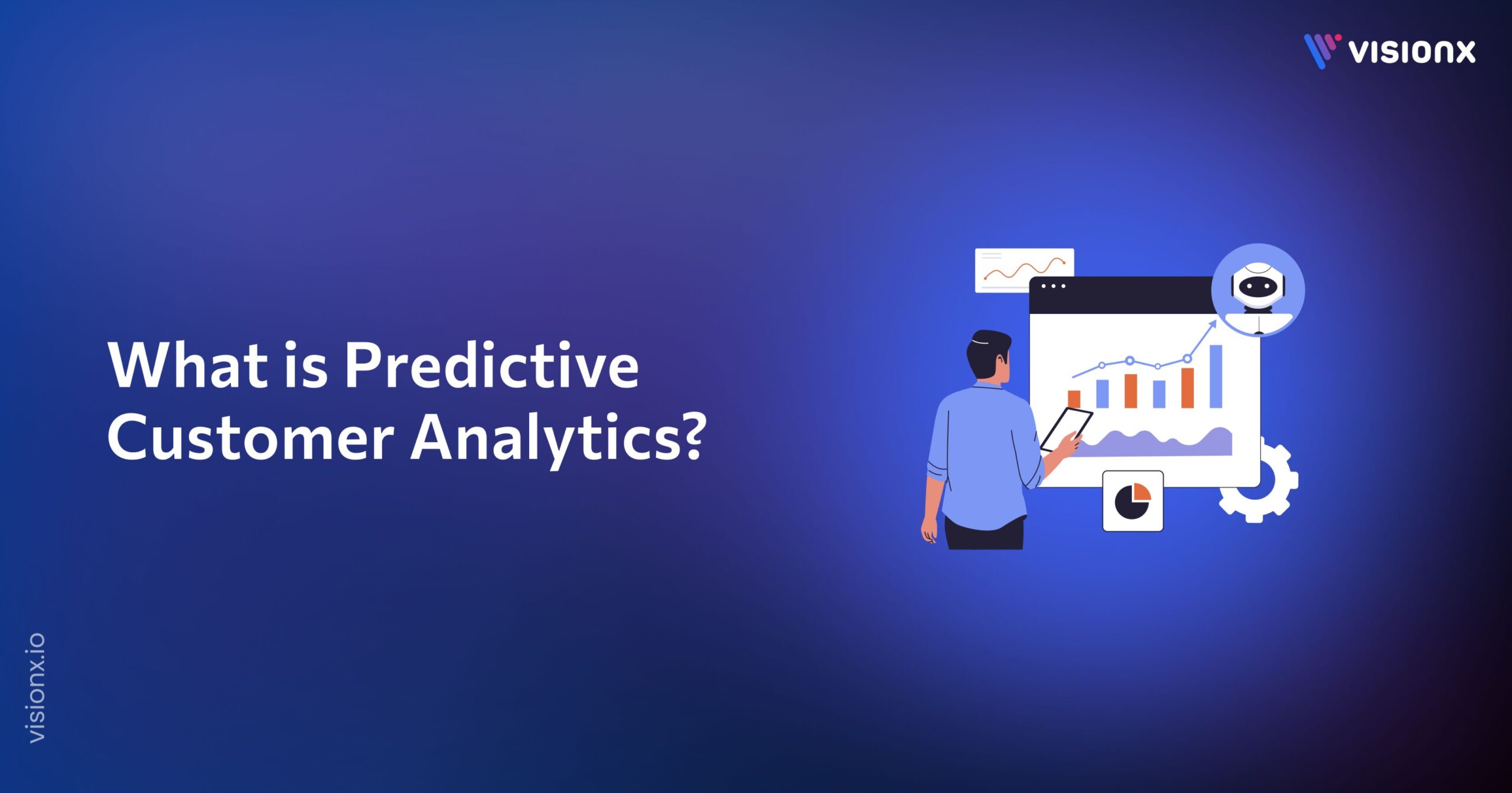
Predictive customer analytics is the practice of applying statistical models and machine learning to historical customer data in order to forecast future behavior, preferences and needs. It answers what a customer is likely to do next, and how likely they are to do it.
The method pairs a company’s own records with AI and machine learning to score outcomes that have not happened yet. Instead of reacting to activity that is already over, teams act on patterns tied to churn, buying intent and individual engagement. That is the whole difference between customer analytics and customer predictive analytics: one describes, the other anticipates.
In practice, it means gathering customer data, running it through algorithms suited to the question, and producing predictive customer insights a team can act on: which accounts are about to lapse, which product a buyer reaches for next, which message lands at which moment.
Key Components of Predictive Customer Analytics
Three components carry the work:
- Data: Transaction history, demographics, on-site behavior and engagement metrics, covering the whole customer base rather than a convenient slice of it.
- Modeling: Statistical methods, artificial intelligence, and machine learning applied to map the patterns that matter.
- Prediction: Scores and recommendations that steer real choices in marketing campaigns, customer service, and retention.
The Role of Predictive Analytics in Data Analytics
Four kinds of analytics sit in sequence, each answering a different question. The distinction between predictive analytics vs descriptive analytics is the one that trips teams up most often: descriptive work explains the past; predictive work commits to a view of the future.
| Type | Question it answers | Example | Output |
| Descriptive | What happened? | Last quarter’s ticket volume and repeat-purchase rate | Reports and dashboards |
| Diagnostic | Why did it happen? | Tracing a sales dip to a checkout change | Root causes |
| Predictive | What is likely to happen next? | Scoring which subscribers will lapse in 60 days | Probabilities and forecasts |
| Prescriptive | What should we do about it? | Choosing the offer that saves the account most cheaply | Recommended actions |
How Does Predictive Customer Analytics Work?
Predictive customer analytics works in five stages: collect customer data, prepare it, build models on it, validate and deploy those models, then monitor and retrain them as behavior changes. Each stage decides how much the next one is worth.
1. Data Collection
Three families of data drive customer behavior prediction:
- Transactional: Purchase history, order frequency, spend patterns.
- Behavioral: Site and app sessions, clicks, campaign response, product usage.
- Demographic: Location, age band, stated preferences.
Twelve to twenty-four months of history is a reasonable starting point for most consumer models, and support tickets belong in the set from day one. Retailers with physical locations add in store customer analytics, such as footfall, basket mix and visit gaps, which often explain behavior that online data alone cannot.
2. Data Preparation
CRM systems, marketing platforms, and service desks all store information about the same customers, but in unique ways. The consolidating, cleaning, and arranging of these records into a reliable format is, however, the least appealing process, but the one that determines the quality of the final model. Predictive analytics CRM integration is especially important because of the fact that a score not transferred to the CRM updates nothing
3. Model Building
AI, machine learning, and classical statistics can identify patterns that lead to outcomes such as when someone cancels their subscription or reacts to a campaign. The usual tools include regression and decision trees as well as neural networks, classification, clustering, and time series analysis. Choosing the model must come after knowing what question is being answered.
4. Model Validation and Deployment
A model should be tested against previously unknown data before having an impact on the customer. Precision and recall are of utmost importance in churn scenarios as labeling customers as ‘safe’ may lead to high accuracy, yet it may be unhelpful.
After proving itself effective, the model goes into operation, where all kinds of decisions are made: retaining customers, choosing campaigns and transferring to services.
5. Ongoing Monitoring and Refinement
Customer behavior changes with seasons, prices, and products, so even a model that has been trained in the past year will drift. New data flows back in, performance is evaluated against the pre-trained model, and retraining is triggered once the lift begins to diminish. Many organizations that skip this step end up thinking that predictive analytics is useless.
Core Techniques Used in Predictive Customer Analytics
A handful of techniques carry most of the load:
- Regression Analysis: Estimates continuous outcomes such as spend, order value or time to next purchase. It underpins most work on predictive analytics for customer retention.
- Decision Trees: Map the branches a customer might take and the likely result of each, which makes them easy to explain to the people who have to act on them.
- Neural Networks: Find complex, non-linear patterns across large volumes of data where simpler methods flatten the signal.
- Classification and Clustering: Group customers by shared characteristics, the basis of customer segmentation predictive analytics, and targeted campaigns that do not annoy the wrong people.
- Time Series Analysis: Reads trends and seasonality over time, supporting demand forecasting and inventory management.
- Customer Lifetime Value Prediction: Projects the total contribution of a relationship, so acquisition and retention budgets follow value rather than volume.
Types of Predictive Customer Models
Here are the most common types of predictive customer models.
| Model | Signals it reads | What it outputs | Decision it drives |
| Churn risk | Usage decline, order gaps, missed payments, support contacts | Probability of leaving in a set window | Who gets a save offer, and how generous it is |
| Purchase propensity | Browsing, cart activity, past category buys | Likelihood to buy a product or category | Which offer goes to which list |
| Lifetime value | Spend history, margin, tenure, return rate | Projected value of the relationship | Acquisition budget and service tiering |
| Next best action | Recent behavior, open cases, campaign history | Ranked list of possible actions | What an agent or email says next |
| Demand and contact volume | Seasonality, promotions, weather, local events | Forecast by product, site, or interval | Stock levels and shift rosters |
Key Use Cases & Applications of Predictive Customer Analytics
Five applications account for most of the value companies report.
Customer Churn Prediction and Retention Strategies
A customer churn prediction model scores each account on its risk of leaving inside a set window, using signals like falling usage, longer gaps between orders, missed payments and a run of support contacts.
Telecoms have run these models for years, and the pattern holds across subscription businesses: work on predictive analytics customer retention pays off because keeping a customer costs less than replacing one. The score only helps if it lands in a workflow, so pair it with a defined save action per risk tier.
Personalized Marketing and Product Suggestions
Predictive analytics in marketing turns behavioral data into personalized recommendations and offers timed to the individual. This is where predictive analytics for marketing can improve campaign decisions. Instead of sending the same message to every customer, marketers can estimate purchase intent, engagement likelihood, and preferred products.
Amazon’s recommendation engine and Netflix’s ranking of what to watch next are the widely cited examples; Netflix has said most viewing starts from a recommendation rather than a search. Applied to predictive analytics customer experience, the same approach raises engagement and conversion without raising spend.
Customer Segmentation and Targeted Campaigns
Predictive customer segmentation groups people by what they are likely to do rather than by who they are, using behavior, preference and projected lifetime value.
This approach turns predictive analytics customer behavior into practical audience segments. Marketers can identify customers who are likely to purchase, disengage, upgrade, or respond to a particular offer.
Segments built this way age more slowly than demographic ones, and they make campaign targeting a matter of intent.
Demand Forecasting and Inventory Optimization
Historical and live data together give a usable view of demand by product, location and week. Starbucks is open about using analytics to choose store sites and plan for local demand, drawing on traffic patterns, demographics and purchase behavior. The operational result is familiar: less waste, fewer stockouts on the lines that sell.
Optimizing Customer Support
Predictive customer service anticipates the reason a customer is about to get in touch and acts first. Call center predictive analytics forecasts contact volume by interval so staffing matches demand, routes high-value or high-risk customers to the right agent, and flags repeat-contact drivers that quietly generate their own workload.
In a predictive analytics contact center, that becomes predictive support in the plainest sense: the troubleshooting message, the proactive credit, the callback offered before the queue builds.
Real-World Examples of Predictive Customer Analytics
The following are four predictive customer analytics examples.
- Retail and E-commerce: Recommendation engines rank what a shopper is most likely to want next. Amazon and Netflix are the standard reference points; Netflix has said the majority of viewing begins with a recommendation rather than a search.
- Banking: Fraud models score a transaction in the time it takes to authorize it, weighing device, location, and spending pattern against the account’s own history.
- Subscription and Telecom: Churn scoring has been standard practice in telecoms for two decades and now runs across SaaS, media and utilities, usually paired with a tiered set of retention offers.
- Food Service and Physical Retail: Demand and location models plan sites, staffing, and stock. Starbucks has described using analytics on traffic patterns, demographics, and purchase behavior to decide where new stores go.
Benefits of Predictive Customer Analytics
The following are the major advantages of using predictive customer analytics in business operations:
Improved Decision-Making
A forecast narrows the range of plausible outcomes, which is what makes planning possible. A customer analytics strategy grounded in model output replaces opinion with probability, and it makes disagreements about priorities resolvable.
Enhancing Consumer Experience and Satisfaction
Anticipating what someone needs produces interactions that feel considered rather than generic. Predictive analytics in customer experience directs attention to the campaigns, products and service moments that actually move satisfaction, instead of spreading effort evenly across all of them.
Increased Revenue and ROI
Models identify the customers worth investing in and the ones already committed, so budget stops subsidizing conversions that would have happened anyway. Measured against a holdout group, the revenue effect of customer predictive analytics is straightforward to prove or disprove.
Operational Efficiency and Cost Reduction
Demand forecasts size inventory, contact forecasts size shifts, and risk scores decide where retention effort goes. Each one removes a cost that comes from planning blind.
Competitive Advantage
Reading a shift in demand a few weeks before competitors do compounds into pricing, stock and campaign decisions they cannot match on timing. The advantage is not the model; it is the shorter gap between signal and action.
Challenges and Considerations in Predictive Customer Analytics
Predictive customer analytics models commonly face the following challenges:
Data Quality and Integration
A model inherits the flaws of its inputs. Duplicate records, missing identifiers and service data locked away from marketing data will cap accuracy no matter which algorithm runs on top.
Privacy Compliance
These models run on personal data, which brings GDPR, CCPA and sector rules into scope. Lawful basis, retention limits and a clear answer to “why does this customer have this score” all need settling before deployment, not after.
Investment in Technology and Resources
Running this properly takes infrastructure, skills and maintenance. Some teams buy a predictive customer analytics platform, others build on their existing warehouse, and the honest comparison is between total cost over three years and the value of the decisions each option improves.
Balancing Automation with Human Insight
Models propose; people still decide. Pairing automated forecasts with commercial judgment keeps predictive analytics in customer service both practical and defensible, particularly where a score affects what a customer is offered.
Choosing Tools: Build, Buy or Extend
Four routes exist, and any honest predictive analytics tools comparison starts with the decision you want to improve rather than the feature list.
| Route | Suits | Trade-off |
| Scoring built into your CRM or CDP | Teams that need a score inside an existing workflow tomorrow | Limited control over features and thresholds |
| Packaged customer behavior prediction software | Common problems such as churn and propensity, on clean data | License cost scales with contacts, not with value |
| Models on your own warehouse | Organizations with data engineering already in place | Needs ongoing ownership, not a one-off build |
| Custom models with a partner | Non-standard signals: store footfall, sensor data, sector-specific behavior | Higher upfront effort, better fit to the actual business |
Best Practices for Predictive Customer Analytics Success
The following best practices will assist businesses in maximizing the potential of predictive customer analytics:
- Define the decision before the model. Name the outcome you want to change, such as reducing churn in a segment or lifting campaign response, and the metric that will show whether it moved.
- Centralize and integrate data. One customer view across purchase, behavior and service records, with the score written back into the systems teams already work in.
- Choose tools that fit the question. Weigh model building, deployment and monitoring together; a platform that predicts well but cannot deliver a score into a workflow solves nothing.
- Work across teams. Marketing, sales and service should read the same predictive customer insights, or the same customer gets three uncoordinated approaches.
- Monitor, test and retrain. Track lift against a control group, review model performance on a schedule, and retrain when behavior shifts.
How to Measure Whether It Is Working
Two sets of numbers matter, and confusing them is how programs lose their budget.
- Model Quality: Precision, recall and lift over a baseline. On a churn problem, accuracy alone flatters a bad model: predict that nobody leaves and you will be right most of the time and useful to no one.
- Business Result: Retained revenue, campaign response, cost per resolved contact, stock write-offs avoided. Measure these against a control group held back from the model’s reach, or the numbers prove nothing.
Review both on a schedule. Model performance decays quietly, and the first sign is usually a business metric drifting back toward where it started.
How VisionX Uses AI to Power Predictive Customer Analytics
At VisionX, we develop custom gen AI models that are relevant to your business. By combining the power of data science, predictive models, and advanced analytics, we empower you to forecast customer behavior, maximize your marketing approaches, and improve your service delivery.
Our specialists develop AI models that integrate directly into your business processes, turning predictive intelligence into practical, actionable results.
Let VisionX serve as your guide to using the power of AI to make well-informed decisions, improve customer retention, and boost customer engagement.
FAQs
What is predictive analytics in customer analytics?
Predictive analytics in customer analytics uses historical data, statistical models, and machine learning to forecast future customer behavior. It helps businesses anticipate needs, optimize marketing strategies, and improve retention.
What is predictive customer analytics experience?
It uses forecasting to make customer interactions feel intentional, offering relevant products or messages proactively so the experience feels personalized rather than automated.
What is the main goal of predictive customer analytics?
To shift from reacting to past behavior to anticipating future behavior, reducing the gap between a data signal and action, which improves sales and retention.
What data do you need to get started?
Typically twelve to twenty-four months of transaction history, behavioral data, and support records, connected through a consistent customer identifier. Limited data simply narrows the first use case.
How long does implementation take?
A focused first model, such as churn prediction for one segment, usually reaches production in six to twelve weeks, mostly spent on data preparation and integration.
Is predictive analytics the same as machine learning?
No. Predictive analytics is the objective, and machine learning is one method used to achieve it. What matters most is whether the results lead to better decisions.