On a daily basis, companies miss opportunities through routine activities that take longer than they should. Agentic process automation (APA) can take care of those monotonous tasks in your organization. With AI agents and autonomous automation, it controls intricate processes on its own, thus letting your teams work on high-value initiatives.
The process automation market is witnessing a rapid rise. The worldwide business process automation market is estimated to grow to about USD 33.7 billion by 2032, revealing the increasing demand for intelligent, digital workflow solutions.
The company that employs agentic AI process automation can not only speed up the business processes but also lower the rate of mistakes and have better communication among the different divisions of the company.
In this article, we will define what agentic process automation is, how it developed from Robotic Process Automation and Intelligent Automation, and its key characteristics. We will also look at its real-life examples to have a better understanding of the concept.
Key Takeaways
- Agentic process automation is an advanced automation approach where autonomous AI agents manage entire workflows, make decisions, and adapt in real time without relying on fixed rules.
- It evolves traditional automation by combining reasoning, context awareness, and self-correction to handle complex, dynamic business processes.
- APA expands automation beyond simple tasks, enabling end-to-end outcomes through multi-agent coordination and unstructured data processing.
- Businesses gain higher accuracy, operational resilience, and efficiency while teams shift their focus from repetitive work to strategic initiatives.
- Adoption brings major advantages but also challenges, including technical complexity, governance risks, and the need for continuous oversight and organizational readiness.
What is Agentic Process Automation?
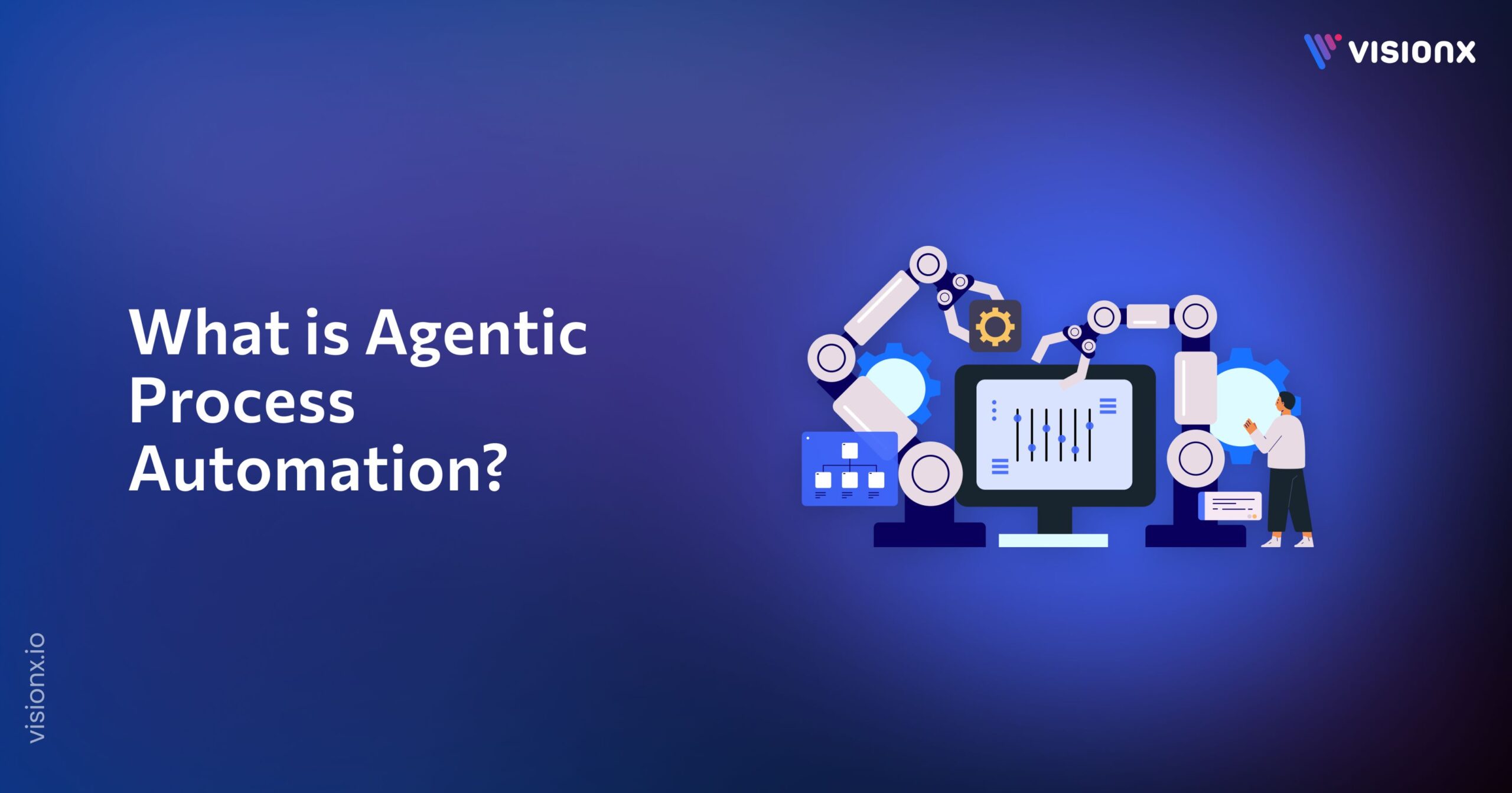
Agentic process automation is a next-generation approach to managing workflows. It is a framework for orchestrating and executing complex work using autonomous AI agents that are often powered by Large Language Models (LLMs) and Generative AI to pursue a high-level goal.
Every AI agent addresses problems at an individual level and collaborates with others to handle cross-functional operations and unstructured tasks, which traditional automation cannot. While agentic AI for process automation ensures daily activities run effectively, teams are free to concentrate on strategy and growth.
According to recent studies, 69% of businesses have already implemented automation in at least one key business operation. This indicates that companies are prepared and willing to go beyond basic rule-based solutions.
If your company has the right agentic process automation system, it can monitor the progress in real-time, react to the changes quickly, and ensure that the work is moving smoothly from start to end.
The Evolution of Automation: From RPA to APA
The road to workflow and process automation could be depicted as a gradual increase in intelligence and independence. It has moved through three main phases, from basic rule-based tools to completely autonomous agents:
- Robotic Process Automation (RPA): The very first phase, where the focus was mainly on the automation of rigid and repetitive tasks via human-like actions performed on the screen, according to pre-set rules.
- Intelligent Automation (IA): The second phase, which enhanced RPA, included the integration of cognitive automation technologies such as AI, machine learning, and natural language processing to manage unstructured processes and make conditional decisions within a specified workflow.
- Agentic Process Automation (APA): The present stage, which is utilizing autonomous agents and agentic process automation tools to manage workflows that are evolving and developing on their own. These agents can plan, reason, and self-correct dynamically, while still allowing for end-to-end automation of tasks that were previously impossible to automate.
Core Concepts of Agentic Process Automation
Agentic process automation has an entirely different approach compared to the traditional automation methods. To see why it matters for your business, it helps to understand a few core concepts.
AI Agents and Autonomous Agents
The foundation of agentic AI process automation is represented by these two terms. Each agent possesses the capability to act independently, process information, and make decisions instantly. They are grouped into a multi-agent system, where their collaboration and interface between departments help facilitate complex workflows.
Autonomy and Context Awareness
AI Agents are not just instructed to act. They know what is going on, change their behavior, and deal with dynamic working processes and unstructured processes without being monitored all the time.
Cognitive Automation and Reasoning
Agentic AI for process automation combines problem-solving skills with cognitive automation. Agents are able to plan, reason, and learn based on past acts in order to enhance performance in the future.
Workflow Orchestration and Process Orchestration
Agents coordinate multiple activities and groups to ensure everything runs smoothly. The workflow and process automation are done smoothly, with practically no hurdles and quick responses to changes.
Adaptive Workflows and Exception Handling
The workflows are flexible and can react to unexpected events. The AI agents detect problems, rectify them, and continue operations without requiring human intervention.
How Does Agentic Process Automation Work?
Agentic Process Automation (APA) functions by employing a sophisticated, self-directing AI entity to pursue a defined organizational objective. The process is inherently circular, designed for continuous adaptation and learning, often referred to as the Cognitive Loop.
1. Ingestion and Situational Awareness
The process begins with the agent receiving a Goal (for example, “Resolve a security vulnerability”) and gathering the perception data.
- Goal Interpretation: The agent’s reasoning engine, often powered by Large Language Models (LLMs), translates the high-level objective into a structured internal task.
- Context Retrieval: The agent queries internal and external sources like databases, knowledge graphs, and logs to gain full situational awareness and understand constraints in the automation process.
2. Autonomous Planning and Strategizing
This stage is what separates agentic process automation (APA) from linear automation. The agent is not constrained to a single script, but instead it formulates its own plan dynamically.
- Action Decomposition: The main goal is divided into smaller, prioritized sub-goals by the agent.
- Tool Selection: The agent chooses the most appropriate agentic process automation tools for every subtask, including calling an API, operating an RPA bot, or producing content using Generative AI.
- Anticipatory Pathing: The agent comes up with backup plans to deal with potential exceptions before they actually happen.
3. Execution, Orchestration, and Tool Use
The AI agent acts as a central workflow orchestrator across systems.
- Action Dispatch: It executes sub-tasks by ordering external tools to perform operations such as retrieving files, updating records, or even running software.
- Workflow Management: The agent controls the transition between stages, making certain that the results of one tool are passed on easily to the next, thus connecting various automation process systems without any interruption.
4. Self-Correction and Learning
Agents keep processes moving toward the goal, even when unexpected issues occur.
- Error Monitoring: They are always monitoring the output for any mistakes or deviations.
- Dynamic Re-Planning: If there are any problems, the agent will examine the issue, throw away the failed sub-plans, and come up with a new plan while automatically taking care of the exceptions.
- Memory Update: Successful and unsuccessful actions are fed back into the agent’s memory, enhancing its decision-making, planning, and performance in future workflows.
Simply stated, APA provides a cycle of informed decisions and actions until the goal is achieved with end-to-end automation and adaptive workflows of complex business processes.
Key Capabilities and Features of Agentic Process Automation
Agentic AI process automation is known for handling business workflows intelligently, adaptively, and independently with the following features:
1. Cognitive and Reasoning Features
These features allow the APA agent to analyze information and make complex, human-like decisions:
- Goal-Driven Autonomy
An agent receives a high-level objective and independently designs, prioritizes, and manages the entire process of achieving it. It is not constrained by any pre-established script and offers self-sufficient automation for intricate business processes.
- Context-Aware Decision Making
Using Large Language Models and agentic AI, the agent processes data from multiple sources to understand the real-time context of the process. This ensures decisions are accurate, aligned with business rules, and effective for cross-functional workflows.
- Unstructured Data Processing
APA agents are experts at extracting structured data and meaning from unstructured sources such as emails, contracts, customer chat logs, and free-form documents. This improves operating efficiency and eliminates dependence on inflexible templates.
- Continuous Adaptive Learning
The agents keep track of how their actions turn out. Learning from successes and failures via a feedback loop, they automatically perfect methods and increase performance for the next dynamic processes.
2. Execution and System Features
These features allow the agent to execute plans effectively across the organization:
- Dynamic Re-Planning and Exception Handling
The agent self-corrects by creating a real-time new execution path when system malfunctions, data anomalies, or errors arise. This guarantees constant development and lowers the need for human intervention in difficult processes.
- Seamless Tool Orchestration
To finish subtasks effectively, the agent serves as a central workflow organizer, combining several tools, including APIs, databases, cloud services, and already operational Robotic Process Automation bots.
- End-to-End Workflow Management
Agentic process automation controls and automates non-linear processes across several departments and systems. Delivering end-to-end automation ensures the completion of overall business results rather than only discrete activities.
- Multi-Agent Coordination
The framework supports multiple autonomous agents collaborating on a shared goal. Specialized agents, such as a “Data Extraction Agent” or a “Compliance Agent,” coordinate under a master orchestrator to ensure seamless execution across process automation systems.
APA vs Other Automation Approaches
Here is a simple breakdown of what sets APA apart from RPA and IA.
| Feature | Robotic Process Automation (RPA) | Intelligent Automation (IA) | Agentic Process Automation (APA) |
| Intelligence Level | Low (Rule-Based) | Medium (Context-Aware) | High (Autonomous & Cognitive) |
| Core Mechanism | Follows fixed, predefined scripts and rules. Mimics human clicks/keystrokes. | RPA combined with cognitive tools (NLP, ML, OCR). | Autonomous AI Agents (LLM-driven) that reason and plan. |
| Decision-Making | Static. Decisions based only on explicitly programmed “if/then” logic. | Conditional. Decisions based on data analysis or pattern recognition within a fixed flow. | Dynamic. Interprets context, exercises judgment, and formulates novel solutions. |
| Adaptability & Exceptions | Brittle. Fails on any unexpected exception, requiring human intervention and reprogramming. | Limited. Can handle minor data variations, but the overall workflow is still rigid. | Highly Adaptive. Employs dynamic re-planning and self-correction to navigate errors and process changes. |
| Scope & Goal | Task Automation. Automates a specific, narrow action. | Process Automation. Automates a sequence of steps, often with human hand-offs. | Outcome Automation. Manages the entire end-to-end goal across multiple systems and silos. |
| Analogy | A digital script-reader who can’t deviate. | A digital form-filler who can read handwriting. | A digital senior manager who designs the strategy and manages the team to achieve the goal. |
| Human Involvement | High & Frequent. Needed for setup, maintenance, debugging, and handling all exceptions. | Moderate & Frequent. Needed for oversight, validation, model training, and complex hand-offs. | Low & Strategic. Needed for setting the initial objective, reviewing high-level outcomes, and managing rare, truly unprecedented failures. |
Business Benefits of Agentic Process Automation
Here are the main advantages of agentic AI process automation.
1. Massive Expansion of Automation Scope
APA can automate the complex, messy processes that traditional automation (RPA) breaks on. Because the AI agent can think and figure out a new plan when things go wrong, businesses can automate entire business outcomes (like handling an entire customer journey) instead of just small, easy steps. This means much more of the business runs itself.
2. Superior Operational Resilience and Agility
Agentic automation is tough and flexible. The agent keeps on going and fixes the issue itself when a computer system fails, a document is lost, or a rule changes. This stabilizes the company process and lessens the need for individuals to frequently intervene and fix problems. This lets the firm react rapidly to shifting regulations or markets.
3. Strategic Resource Repurposing
Agent-based automation takes over the tasks that require human thinking, like solving exceptions or gathering information from different places. As a result, by handling this complex “thinking work,” APA frees up valuable employees to focus on things that only humans can do well, like creativity, strategy, and deep customer relationships. Consequently, people spend less time fixing problems and more time creating new value.
4. Enhanced Data-Driven Accuracy and Consistency
The APA agent looks at all the data (emails, documents, databases) instantly and together. With this comprehensive view, it makes reliable decisions every time. This guarantees that processes are run with perfect accuracy and that company rules are followed consistently, which helps reduce costly mistakes and keeps the business safe from compliance risks.
Industry Use Cases and Applications
Here’s how agentic AI process automation is applied in various industries:
- Finance: AI agents are responsible for automating the processing of documents, fraud detection, and regulatory reporting.
- Healthcare: Patient data, scheduling, and claims are taken care of by autonomous automation, which in turn reduces the burden of administration.
- Supply Chain: The adaptive workflows for inventory, order tracking, and disruptions are enabled, which in turn enhances the efficiency of the entire process.
- IT and Customer Support: A multi-agent system is in place that takes care of ticketing, system monitoring, and incident resolution with very little human intervention.
- Marketing and Sales: Contextual AI is deployed to perform tasks like lead qualification, campaign management, and client personalized interaction, among others.
- Emerging Applications: Sustainability reporting, ESG compliance, personalized education, and advanced workflow orchestration are some of the areas where technology will be applied.
Challenges and Considerations for APA Adoption
Agentic process automation is a technology that can change the whole scenario of business operations. However, it poses difficulties that the organization must be ready to face:
1. Technical and Infrastructure Challenges
Firstly, agentic AI for process automation is expensive and complex to deploy. In addition, it requires high-cost computing power (GPUs) for the AI models and demanding work to connect the smart agent with all the company’s existing and often older computer systems. It requires specialized AI experts and not just standard programmers.
2. Governance, Risk, and Security Considerations
Because the agent thinks for itself, it creates a “black box” problem, making it hard to trace why it made a decision, raising major audit and compliance risks. Since the autonomous agent needs access to many sensitive systems, it is a high-level security target that requires strict protection.
3. Organizational and Cultural Hurdles
Employees often do not trust the agent to handle important, complex tasks, leading to resistance. Companies must lead a strong change management effort to build confidence and help staff understand that the agent is there to take over the difficult work so they can focus on new, strategic projects.
4. Continuous Monitoring and Validation
The agent’s intelligence can slowly become inaccurate over time. This means that even after setup, human teams must constantly monitor and validate the agent’s decisions and performance to ensure it stays reliable, accurate, and aligned with current business rules.
The Future of Agentic Process Automation
Early adopters of agentic process automation (APA) will have a competitive advantage as it is developing rapidly. The following are some of the changes that will take place in the coming time:
- Hyper-Personalization
AI agents customize processes and judgments to particular business environments, enabling highly customized customer experiences and targeted operations.
- Integration with IoT and Real-Time Data
Moreover, by linking with IoT devices, sensors, and outside data streams, APA will provide situational awareness, contextual AI, and dynamic workflows that respond instantly to changes.
- Predictive Decision-Making
Using Generative AI and LLMs, agents will predict problems, maximize resource use, and offer solutions before they even exist.
- Human-AI Collaboration
Instead of pushing humans aside, agentic process automation acts as a decision-making partner by providing insights, performing routine tasks, and assisting with large-scale problem-solving, planning, and reasoning. It will enable humans and machines to collaborate rather than replace human workers.
How VisionX Helps Simplify Agentic Process Automation
At VisionX, we help your business turn agentic process automation into a practical, working solution. We combine our expertise in Generative AI and Data Science to create AI systems tailored to your workflows and business needs.
We design the right AI infrastructure, develop custom models, and embed automation into web, mobile, or enterprise systems, guiding every step of the process.
Talk to our AI team today and start moving toward scalable agentic automation.
FAQs
What is process automation?
Process automation uses technology to complete repetitive tasks without constant human effort. It includes everything from basic RPA to advanced workflows managed by agentic process automation systems.
How to implement agentic process automation?
Begin with a pilot on key processes, introduce AI agents, monitor outcomes, and scale gradually. Refine adaptive workflows along the way to ensure efficiency and reliability.
What are the 4 stages of process automation?
1. RPA: Automates repetitive, rule-based tasks 2. Intelligent Automation: Adds AI to handle unstructured data and conditional decisions 3. Agentic Process Automation: Uses autonomous agents for dynamic planning and decision-making 4. Optimized Enterprise Automation: Integrates multiple APA workflows for fully adaptive, self-improving operations
What is an example of an agentic workflow?
A common example is automated invoice processing. AI agents extract data, validate it, update ERP systems, and learn from previous errors to improve future performance, all without manual intervention.