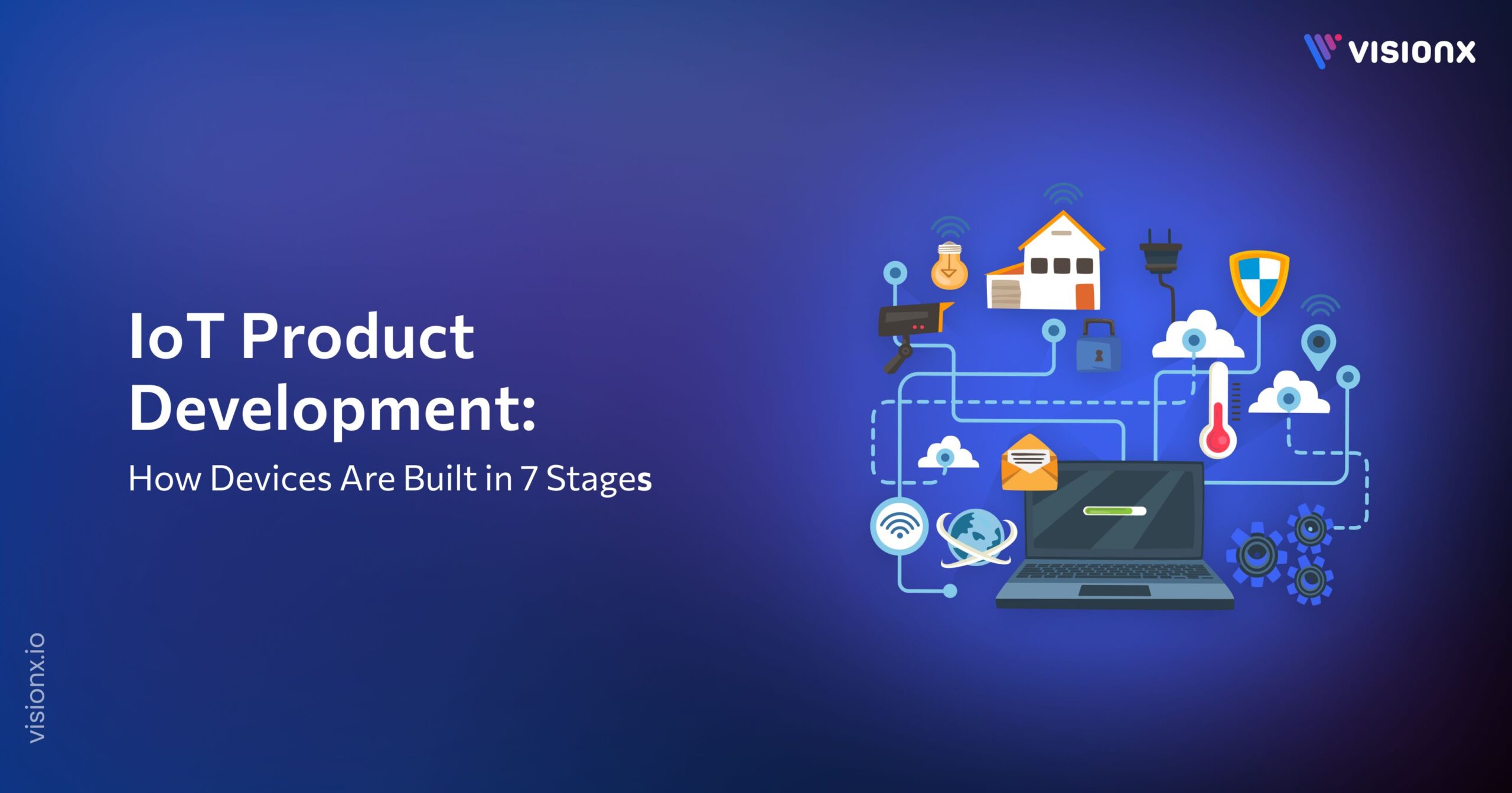
New connected devices have a notably high failure rate. Bringing your IoT device to market involves overcoming a different terrain, the intersection of electrical engineering, deep software, and international logistics. Contrary to traditional software, an error in IoT product development might require an expensive hardware and firmware recall rather than just a quick update.
How do you bridge the massive gap between a brilliant idea and a profitable, scaled, mass production-ready IoT product?
You need a clear, strategic map if you want to navigate this complex IoT product development process successfully. The main distinction between a successful, scalable launch and an expensive market failure is awareness of the whole IoT product development life cycle.
With a market value expected to surpass USD 4,062.34 billion by 2032 as connected solutions continue gaining popularity worldwide, the global Internet of Things product development ecosystem is expanding quickly.
This guide breaks down the complex journey of building IoT devices into seven strategic stages that define successful IoT product development.
Key Takeaways
- IoT product development is an end-to-end process that combines hardware, firmware, cloud, and mobile technologies to deliver secure and connected devices.
- The IoT product development life cycle is split into distinct phases, from IoT product concept development to mass production.
- Your success relies on managing technical challenges like hardware and firmware integration, scalability, and regulatory compliance.
- Treat security and quality control as priority design considerations from the very first stage of IoT product development to ensure long-term viability.
What is IoT Product Development?
IoT product development is the specialized, end-to-end process for designing, engineering, and deploying smart, connected physical devices. In comparison to traditional software, IoT product engineering involves the combination of three different layers to produce a complete product solution:
- The Physical Layer: This layer comprises IoT hardware development and IoT product design. It refers to the physical components of the IoT device, including sensors, actuators, processors, and communication modules.
- The Embedded Layer: This is the firmware and hardware programming that runs directly on the device’s chip. It defines the device’s function, controls the power consumption, and selects the data transmission protocols.
- The Cloud Layer: This comprises the infrastructure of the IoT software development. It is the remote brain that securely receives, stores, and analyzes the data-driven insights collected by the device, often providing a user experience through a mobile app.
This entire process is called the IoT product development life cycle. It is an end-to-end challenge that requires expertise in electronics, embedded software development, and large-scale cloud computing.
The 7 Stages of IoT Product Development
The journey from an idea to a market-ready solution, an internet-connected device, is backed up by a strict IoT product development life cycle. It is essential to properly go through these seven strategic stages to reduce risk and ensure that your IoT device is produced in large volumes smoothly.
Stage 1: Idea and Conceptualization
At this crucial initial step, you will determine the business requirement and the IoT product’s core value. It is during the IoT product concept development that the whole scope of the project is set, and that means you have to clearly state what problem your product solves. You have to identify the target environment and record the expected user behavior.
You also need to establish high-level, non-negotiable conditions, including anticipated battery life, required network protocols (e.g., Bluetooth, cellular, LoRa), and the anticipated level of security required for data encryption. This base work guides any further engineering decisions across the entire IoT product development team.
Stage 2: Market Research and Feasibility
Before heavily investing in IoT device development, you have to clearly demonstrate that the concept is financially viable and technically possible in order to avoid a major risk. The proof of this concept includes thorough market research and competitive analysis to establish the unique selling proposition.
It also requires a technical feasibility study that reviews component availability, protocol support duration, and the overall complexity of the integration process. This comprehensive analysis guides you in selecting the most viable technology stack and, at the same time, guarantees that your first product has a target cost structure that is compatible with profit generation.
- Market Research: Define your competitive advantage and close market gaps by thorough competitor and current IoT solution research.
- Technical Feasibility: Evaluate the stability and availability of major components and prepare based on the complexity involved in the IoT and embedded product development.
- Cost Analysis: Determine the initial Bill of Materials (BOM) with component costs, assembly costs, and estimated software licensing costs to verify target manufacturing costs.
For a more detailed overview of budgeting considerations, this guide on software development costs offers valuable context.
Stage 3: Design and Prototyping
Now that the concept has been confirmed, the project will change its focus to tangible IoT product design and development. During this stage, the activities of industrial design will be directed towards the device’s aesthetics, ergonomics, and environmental durability. Meanwhile, mechanical engineering will focus on the casing and internal structures that must accommodate and safeguard the electronics.
The main goal is to make the IoT product design perfect in a way that it has a good balance of aesthetics, function, and manufacturability. This will lead to the creation of various prototypes, ranging from simple “looks-like” models for visual feedback to complex “works-like” functional Proofs of Concept (PoCs) used to assess critical features such as sensor accuracy, data capture, and basic connectivity protocols. In many cases, this also involves an AI Proof of Concept to validate intelligent capabilities early in the development process.
Stage 4: Hardware and Firmware Development
This is the stage when your idea turns into a functioning IoT device. Your hardware team chooses the sensors, communication modules, and microcontroller appropriate for your IoT device’s objectives.
They construct the PCB, analyze electrical behavior, and guarantee the device meets performance and safety criteria. Simultaneously, your firmware team develops low-level code that controls the device, monitors sensors, and guarantees data flows naturally. A clear understanding of the distinction between firmware and software is essential at this stage to avoid architectural gaps.
Main activities in this step
- Sensor and actuator selection and testing.
- PCB design with proper routing and thermal control to ensure reliability.
- Firmware writing for device control and communication.
- Protocol selection, such as BLE, Wi-Fi, LoRa WAN, or NB IoT.
- Incorporation of secure boot, encryption, and OTA updates.
Stage 5: Software and Cloud Integration
After your physical IoT device is stable, attention shifts entirely to the cloud, which is the essential, scalable backbone of the Internet of Things. In this phase, IoT software development is performed, and you need to build the scalable cloud infrastructure required for high-volume data ingestion and storage (data lakes/warehouses). Additionally, it should support complex processing and robust analytics across your potentially large device fleet.
This infrastructure securely gathers data-driven insights and powers your application, which users interact with. This often requires expert IoT application development services to create a mobile or web interface that is fully responsive. Ultimately, the goal is to deliver a complete solution for the end user.
Stage 6: Testing and Validation
This is the stage where you confirm that your IoT product works reliably in real conditions. It’s a critical part of the IoT development life cycle, and it helps you understand how the device behaves once it leaves the lab. Your QA teams test every layer, such as the hardware, the firmware, and the cloud connection, to make sure the entire IoT device is stable and ready for the next phase.
Here’s what usually happens during testing.
- Functional testing to confirm that the device carries out its intended tasks.
- Environmental and stress tests under temperature, pressure, or humidity shifts.
- Connectivity checks across different networks and locations.
- Security testing to validate encryption, authentication, and data protection.
- User acceptance testing to evaluate usability and overall experience.
Stage 7: Production and Launch
This is the final stage of IoT development, preparing the product for large-scale production. Supply chain teams create production molds, set up manufacturing lines, and locate parts. Each device goes through quality control checks to guarantee consistency. To prepare for market distribution, packaging, labeling, certifications, and logistics are completed.
Once the product reaches its final form, marketing teams launch it with a clear value message and user onboarding resources. Post-launch assistance and performance evaluation guarantee that the product works perfectly in the hands of real users.
Common Pitfalls and How to Avoid Them
Despite a thorough IoT product development process, lots of projects get stuck or even fail due to errors that could have been avoided. To make sure your product solution lasts, you must be aware of these pitfalls in IoT development.
Underestimating Hardware Complexity
Many teams apply a software mindset to IoT device development, overlooking the physical limits of hardware and firmware. Once tooling begins, hardware changes become slow and expensive.
- The Mistake: Treating IoT hardware development as simple assembly and ignoring signal integrity, heat management, and power needs.
- How to Avoid: Run deeper testing and validate the BOM early. Make sure components are stable, available, and not approaching the end of life to avoid production delays.
Weak Security Foundations
When security is treated as a late add-on, the result is rework, vulnerabilities, and unstable IoT products.
- The Mistake: Relying on basic encryption or generic cloud security while skipping device authentication, secure key provisioning, and firmware-level penetration testing.
- How to Avoid: Build security into the design. Use hardware security modules and plan for rapid OTA patching within your IoT product lifecycle management process.
Failing the Cost to Scale Test
Prototypes may look affordable, but scaling thousands of units often exposes hidden expenses that hurt long-term profitability.
- The Mistake: Ignoring the real costs of certifications, shipping, tariffs, and component price swings across the product line.
- How to Avoid: Lock down the BOM and perform an industrialization review. Factor in labor, packaging, and quality failure rates to understand true margins.
Neglecting Data Strategy
Data is the core value of any IoT product, and failing to plan for it limits the impact of the entire solution.
- The Mistake: Collecting large volumes of raw or unstructured data without a plan for processing, anonymizing, or converting it into useful insights.
- How to Avoid: Design the cloud backend for analytics early on. Use user behavior and feedback to refine the product and unlock new revenue opportunities.
Important Considerations When Building IoT Devices
Here are a few key considerations to keep in mind as you build your IoT devices.
Security and Data Protection
When making an IoT device, consider security from the beginning. The protection of hardware, firmware, cloud systems, and applications will keep your device out of the hands of intruders. It also ensures that you will not have any incidents in the future and will gain your customers’ trust in your product.
Data Management
Data from your IoT device must be handled properly. Make a storage, processing, and analysis plan that considers user behavior and feedback. Then, transform this information into useful information to support data-driven decisions for your product.
Connectivity Requirements
The functioning of your IoT device is dependent on the reliability of its communication. Select the appropriate protocol for your product, conduct testing in real-world environments, and have a plan for places with poor signals. A strong connection means that your IoT solution will work dependably and will not irritate users.
Scalability and Device Management
If you intend to diversify your product range, build a management system that can grow with your needs. It will enable you to control numerous devices at the same time, process greater amounts of data, and perform remote updates. Early planning for scaling up prevents you from experiencing the difficulties that your IoT device network might encounter in the future.
User Experience and Ease of Use
Always be empathetic toward the user. Make the installation easy, interactions clear-cut, and reactions predictable. A seamless IoT device interaction creates trust and leads to occasional use of your product by consumers.
How VisionX Uses AI to Simplify IoT Product Development
VisionX is an AI development company that offers tailor-made Gen AI solutions to the industry. We understand how tough it can be for you to deal with the complications of the IoT product development process.
By using advanced Generative AI, we make the whole process much easier for your business. This includes speeding up firmware and hardware optimization code generation and applying predictive analytics to life cycle stress test simulations. As a result, the time and cost required for mass production are significantly reduced.
Partner with VisionX to transform your IoT product concept development into a market reality faster and smarter.
FAQs
What is IoT development?
IoT development is the process of creating connected devices that collect, share, and act on data, combining hardware, firmware, software, and cloud integration.
How much does it cost to make an IoT device?
Costs vary by complexity. Simple devices may cost a few hundred dollars to develop, while advanced devices with cloud integration and analytics can cost several thousand dollars per unit during prototyping and production.
What are the challenges of IoT device development?
Challenges of IoT development include ensuring reliable connectivity, security, scalability, regulatory compliance, and a smooth user experience. A structured IoT product development process helps address these issues.
What are the benefits of IoT product development?
IoT product development provides real-time data, automation, predictive insights, and improved operational efficiency while delivering a better experience to users.
What are the future trends in IoT product development?
Future trends in IoT development include AI-powered devices, edge computing, energy-efficient hardware, enhanced security, and deeper cloud integration for smarter and faster IoT devices